
Know what a Plinko listing actually tells you
 Available in AU
A guide to the game format, casino listings and the differences between free play and real-money terms.
Plinko Slots Aren’t the Same as the Pokies You Know
When someone calls a game a Plinko slot, the word “slot” can be doing more work than you’d expect. It may describe how a casino catalogue groups the game, or the software label used for it. It does not automatically mean the game looks or behaves like the pokies you know from a pub or club.
A familiar pokie is built around spinning reels and symbols. You choose a stake, the reels stop, and the game checks the resulting symbol pattern against its paytable. A Plinko-style game borrows the name and visual idea of a puck dropping through a field of pegs, but its central action is not a row of reels stopping on matching symbols. That difference matters when you are trying to understand what a listing is actually describing.
The word “slot” can therefore be a useful filing label and a poor description of the format. Some catalogues group Plinko-style titles alongside slots because they are casino games supplied through gaming software. Others may use “slot” as part of a title or category even when the play screen is quite unlike a standard EGM. I would look at the rules and interface before assuming that a game with “slot” in its description is a conventional pokie.
Choosing a Plinko casino in Australia means checking the details that are actually available before you play. Use these verdicts as a quick reference when deciding which operators to look into further.
1. Golden Pokies
License: Curacao
Golden Pokies lists a Curacao licence. That is the licensing detail available here for your review.
2. Bizzo Casino
License: Curacao Gaming Control Board (TechSolutions Group N.V.)
Bizzo Casino lists a Curacao Gaming Control Board licence under TechSolutions Group N.V. Check this licensing information as part of your research.
3. JeetCity Casino
License: Curacao eGaming (Dama N.V.)
JeetCity Casino lists a Curacao eGaming licence under Dama N.V. This gives you a named licensing entity to consider.
4. Thor Casino
License: Curacao – Antillephone N.V. (Versus Odds B.V.) · Min. deposit: EUR 20
Thor Casino lists a Curacao licence issued through Antillephone N.V. for Versus Odds B.V. Its minimum deposit is EUR 20.
5. Playfina Casino
License: Curacao eGaming (Hollycorn N.V., since 2017) · Min. deposit: A$20-30 (depends on the offer)
Playfina Casino lists a Curacao eGaming licence under Hollycorn N.V., held since 2017. Its minimum deposit is A$20–30, depending on the offer.
6. Roby Casino
License: Curacao eGaming (Roby Games Ltd)
Roby Casino lists a Curacao eGaming licence under Roby Games Ltd. This is the licensing detail available for you to check.
7. SpinsUp
License: Curacao Gaming Control Board OGL/2023/174/0082 (Dama N.V.)
SpinsUp lists a Curacao Gaming Control Board licence, OGL/2023/174/0082, under Dama N.V. The licence reference gives you a specific detail to verify.
8. JustCasino
License: Curacao Gaming Control Board
JustCasino lists a Curacao Gaming Control Board licence. This is the licensing information available for your review.
9. House of Pokies
License: international iGaming licence – jurisdiction not named in the source · Payout speed: PayID 1-24 hours · Min. deposit: A$30 (PayID from A$10)
House of Pokies lists an international iGaming licence, though the jurisdiction is not named in the source. You can deposit from A$30, or from A$10 using PayID, with PayID payouts stated at 1–24 hours.
10. WinSpirit Casino
License: Curacao eGaming OGL/2024/923/0383 (Antillephone N.V.) · Min. deposit: A$30
WinSpirit Casino lists a Curacao eGaming licence, OGL/2024/923/0383, under Antillephone N.V. Its minimum deposit is A$30.
A different screen, a different format
In a typical Plinko presentation, a ball or puck travels down a pegboard and ends in one of several positions. The game’s rules explain how those positions relate to possible results. That is a different visual structure from reels, paylines and symbol combinations. The two formats can both be described as chance-based casino games, but their similarities end well before you can treat them as the same thing.
This is also why a search for a Plinko slot machine can lead to confusing descriptions. “Machine” might suggest the familiar cabinet-style pokie, while the game being described is a digital pegboard format. The label alone does not tell you whether the title uses reels, how results are determined, or what its rules say. Those details belong to the specific game, not to the broad word “slot”.
Some titles combine a themed name with Plinko-style presentation; others may be grouped in a slots section despite using a different layout. A name such as Gods of Plinko, for instance, is not enough to establish the game’s exact rules or software provider. Nor does a phrase like “top slot” tell you anything measurable about quality. It is a label, not a technical description.
The software label is not the game rule
The provider matters because it identifies who made the game, but it does not make all titles from that provider interchangeable. A catalogue entry may show the provider, the title and a return-to-player figure, yet those details answer separate questions. The provider identifies the software source; the title identifies the particular game; and the RTP is a theoretical return figure expressed over extensive play, not a prediction of an individual result.
For context, KA Gaming slot RTP percentages typically range from 94% to 96%. That is a provider-level range, not a statement that every Plinko-style title has the same RTP, or that a particular game’s figure can be inferred from its name. If a listing gives a specific RTP, check that it is attached to the exact title and version being described. A number copied from a provider’s other game tells you very little here.
Best RTP Slots in Australia: How to Compare
I find it helpful to separate three things: the game’s format, the provider’s identity and the catalogue category. They often appear close together on a screen, but they are not synonyms. A Plinko-style game can be filed under slots without turning into a reel-based pokie. A familiar provider name does not tell you how a particular title plays. And a colourful theme does not explain the rules.
That sounds obvious, until a short listing muddles all three. Then it is not.
What to check in a description
A useful description should make clear whether you are looking at reels or a pegboard-style layout, identify the game’s provider where that information is available, and point to the rules for that exact title. If it calls the game a slot but the screen shows no reels, read the label as a category rather than a literal account of the format.
The same applies to phrases such as “Plinko game” or “Plinko slots”. They can refer broadly to games built around the pegboard idea, but they do not guarantee identical layouts, rules or software. Treat each title as its own product. The name may tell you the theme; it does not replace the game information.
Australian players use “pokies” for the reel-based games they already recognise. That everyday word is more precise than “slot” when you mean those familiar machines. When a Plinko title is called a slot, the best reading is often simply that it sits in a slots category—not that it is another version of the standard pokie.
What an Online Plinko Game Actually Involves
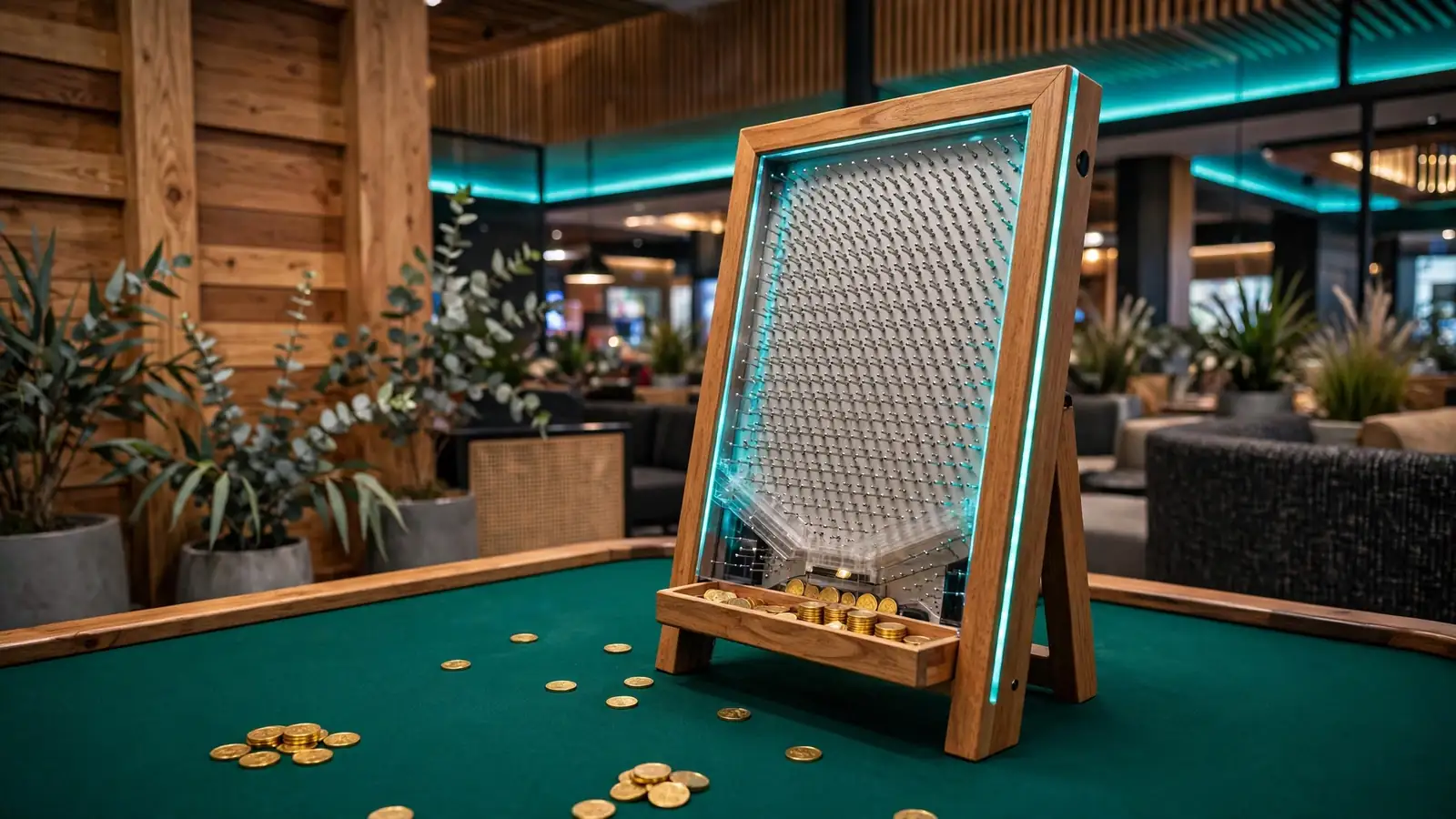
An online Plinko game takes the familiar pegboard idea and presents it on a screen. A ball or disc is released from the top, bounces through rows of pegs, then lands in one of the spaces along the bottom. The space it reaches determines the result shown for that round. That is the basic picture; the details depend on the particular game.
Best-Paying Online Pokies in Australia: What to Know
The board is usually the main event. You watch the ball’s path, rather than choosing cards or steering a character through a level. Some versions let a user select settings such as the board’s layout or the number of rows before a round begins. Others keep those choices fixed. These are design variations, not a promise that every game bearing the Plinko name works the same way.
The visual path can make the outcome feel as if it is unfolding in front of you, peg by peg. That animation is not, by itself, evidence that a person or physical ball is controlling the result. In a digital version, the motion is part of the game’s presentation, and the screen may show a simulated bounce. A lively animation can still be a simple interface. The graphics tell you what the game wants you to see, not necessarily how its result was generated.
What “online” describes
When people call it an online casino game, they are generally describing where the game appears: in a browser or app interface associated with casino-style games. “Online” does not tell you whether the game is built by a particular provider, whether it is a standalone title or part of a larger catalogue, or whether its rules match another Plinko game you have seen. Those details need to be established from the game’s own information.
There is no single Plinko ruleset that can be assumed from the name alone. One title may display different risk settings or board configurations; another may offer a much simpler set-up. Even where two games look alike, their menus, round flow and presentation can differ. Treat the name as a signpost to a broad format, not as a full description of the software.
“Golden Plinko” works in much the same way as a title or branding label. The word “golden” does not identify a separate, universally defined version of the game. It may appear in a product name, a themed interface or promotional wording, but the label alone does not tell you what the board looks like or what rules it uses. Read the title as a name, not a technical specification.
Mines Casino Game in Australia: Rules and Risks
Why “live” can be confusing
The phrase “live Plinko” can suggest a host, a studio or a real-time event, but the word is not enough to confirm any of those things. It may be used to describe a streamed presentation, a live-labelled section of a catalogue, or simply a game that animates each round as it happens. Those are different things.
A genuinely live presentation would involve a visible real-time element, such as a host or a physical set. A digital animation can look immediate without being a live broadcast. If a page uses “live” in its title, look for a plain explanation of what is live: the presenter, the event, or only the display. If that explanation is absent, the label leaves the important point unresolved. “Live” is a label, not an explanation.
Some games combine a stream with an interface that displays a board or round result. In that case, it is useful to separate what the video shows from what the game interface says is happening. A person on screen does not automatically mean that every part of the game is physically operated, and a simulated board does not become a live event just because it is shown beside a video.
Why the name can sound like a pokie
You may also see Plinko described as a pokie or grouped alongside pokies. That is often a loose category label: the site is placing it among casino-style games, rather than carefully explaining the mechanics. The board-and-ball format remains its defining visual feature. The label alone does not tell you whether a particular title uses reels, paylines, bonus rounds or any other feature associated with a different game format.
That matters when you compare descriptions. A phrase such as “casino game with Plinko” may refer to a catalogue containing a Plinko title, not a special hybrid with a shared set of rules. Likewise, “Plinko game online” identifies a general format, not a specific version. You still need the title and its rules to know what is actually being described.
For a clear description, look for the game’s exact name, an explanation of how a round proceeds, and whether the board is simulated or presented as a live event. If those basics are missing, broad labels such as “online,” “casino” and “live” do little work. The format is simple to recognise; the wording around it can be less exact.
Real-Money Play, Withdrawals and the Fine Print
When a Plinko page talks about real-money play, the important detail is not the label on the game. It is what the terms say happens when you try to turn a balance into a withdrawal. A displayed win and money you can actually cash out are not necessarily the same thing.
Start with the withdrawal threshold. Offshore sites commonly set a minimum cashout somewhere between A$75 and A$150. If your balance falls below the stated minimum, you may have to leave it there until it qualifies, or meet other conditions in the site’s rules. Check whether the threshold applies to each withdrawal, whether different payment methods have different limits, and whether the amount shown is before or after fees. Read the wording for the specific account and payment method; a general page may not tell the whole story.
Then look at identity checks. A first withdrawal commonly triggers KYC, short for know-your-customer checks. You may be asked for a passport or driver’s licence, along with a utility bill to confirm your address. The name and details on those documents may need to match the account and payment information. If you use an old address, a shortened name or details that do not line up, expect questions before the request is completed. Keep documents secure, and make sure you understand how the service says it handles them.
The request itself can be subject to checks too. A site may review account details, transaction history or whether its terms have been followed before releasing a balance. That is why it is worth reading the withdrawal rules before treating a displayed amount as money in hand. Note any stated processing steps, required documents and conditions that could hold up a request. If the rules are vague or difficult to find, that is useful information in itself.
New Australian online pokies: checking the claims
Bonus balances need a separate look. Bonus funds are not cash, and winnings derived from them may have to meet wagering requirements before withdrawal. A specialist review described requirements in the range of 30–50 times the bonus amount; that is one review’s account, not a rule that applies to every service. The wording matters: check what amount the multiple applies to, which games count, and whether there are restrictions while the requirement is being met. A balance can look generous on screen while remaining unavailable for cashout.
A no-deposit offer does not remove these checks. “No deposit” describes how an offer begins; it does not establish that the resulting balance is withdrawable without conditions. The terms may still set a wagering requirement, a cashout cap or a document check. Treat the offer text and the withdrawal rules as separate pieces of information, and do not assume that a promotional balance can be withdrawn just because it appears beside your cash balance.
I would also keep a simple record of what the page promised and what you submitted: the terms shown when you opened the account, the withdrawal amount requested, and any KYC documents requested in response. If a condition changes or a request is delayed, that record makes it easier to identify what the site says is outstanding. Avoid sending sensitive documents through an unverified channel, and do not share passwords or one-time security codes with anyone claiming to help.
For an Australian reader, real-money wording is not proof that a service may lawfully be offered here. This is not a recommendation to use one. The practical point is narrower: before relying on any cashout claim, find the threshold, the KYC requirements and the conditions attached to bonus-derived funds. If you cannot tell what must happen before a withdrawal is approved, you cannot judge what the balance means. Read the small print first.
How Plinko Fits Among Casino Games
Plinko sits in an awkward little corner of the casino-game family tree. It is not a card game, a table game or a traditional reel game. Its familiar image is a ball dropped onto a field of pegs, bouncing down towards one of several result spaces. The path looks simple; the result depends on where the ball finishes.
Low-Volatility Slots in Australia: How They Play
That puts it closer to a compact chance game than to games built around decisions such as choosing a card action or placing a roulette bet. A Plinko screen may show rows of pegs, adjustable risk settings or different board layouts, but those details do not turn it into a progressive jackpot game. They describe the Plinko format itself.
The distinction matters because casino games often borrow features from one another in their presentation. A bright jackpot counter, a large potential prize or a casino-style interface does not tell you how the prize is funded. In particular, a Plinko game should not be assumed to share the mechanics of a progressive pokie just because both appear in a casino catalogue.
What makes a jackpot progressive?
A progressive jackpot grows as people play linked pokies. Some progressives are standalone: the prize is tied to a local machine. Others are networked across many machines, or across an operator’s online fleet. In either case, the growing jackpot is a separate feature attached to the game or network. It is not simply another name for a Plinko result.
That is a useful distinction when comparing game descriptions. A Plinko board may display changing outcomes, while a progressive pokie jackpot builds through linked play. One concerns the result of a particular round; the other concerns a prize pool that accumulates across qualifying play. The screen can make both look dramatic. The mechanism is different.
A specialist review advises checking the contribution rate and the minimum bet needed to qualify for a progressive jackpot. Those conditions can affect whether a particular bet counts toward the prize. Some games set a qualifying minimum; A$1.00 is one example, not a rule for every game. Read the game’s own jackpot conditions rather than treating a prominent counter as proof that every stake contributes.
Similar setting, different game
The wider casino category includes games with very different rhythms and rules. A card game asks you to follow hand values and decisions. Roulette centres on a wheel and selected outcomes. Pokies use reels and symbols. Plinko uses a falling ball and a board of pegs. Putting them all under “casino games” describes where they are grouped, not how they work.
High Volatility Slots in Australia: How They Work
The label can also be confusing when a site places Plinko beside table games or pokies. That catalogue position is not a technical classification. Nor does the word “casino” in a title establish that a game has a jackpot, a particular prize structure or a connection to a network of machines. Those are separate details to establish from the game information.
I find it helps to split the description into two questions: what produces the ordinary result, and is there a separate jackpot feature? For Plinko, the first answer is the ball’s route through the board. The second cannot be inferred from the name or the look of the screen. If a progressive prize is claimed, its qualifying rules and connection to a jackpot pool need to be stated separately.
That keeps the categories tidy. Plinko is a ball-and-board casino format; a progressive jackpot is a prize mechanic that may be attached to qualifying linked games. Similar surroundings, different machinery.
Reading a Plinko Review Without Taking It on Trust
A review can help you understand what a page claims, but it cannot prove that every claim is current or applies to every visitor. I look for specifics that can be checked: who published the review, when it was updated, what exact game or service it assessed, and whether its statements match the terms shown on the relevant page. A confident tone is not evidence.
That matters when a review uses a familiar name or a polished label. A reference to MrBeast, or a title such as Plinko Rush, Plinko Verde or Plinko Deluxe, does not by itself establish who made the game, who operates a site, or whether the review assessed the same thing you have in mind. Treat the wording as a clue to what is being discussed, not as verification. If the review does not identify its subject clearly, its verdict is hard to use.
Bonus claims are a useful test of how carefully a review handles detail. “A bonus is available” tells you little unless the conditions are set out alongside it. Bonus funds are not cash: the terms may require wagering before winnings derived from them can be withdrawn. A specialist review gives a specific illustration: a $100 bonus with a 40x wagering requirement would call for $4,000 in bets before bonus-derived winnings could be withdrawn. That is an example reported by that review, not a standing rule for every offer.
The same care applies to game contribution. One specialist review says blackjack may count for only 10% towards wagering requirements. If a review mentions a figure like that, check which offer and terms it describes; do not assume the figure transfers to a different promotion. Small print has a long memory, even when the headline does not.
I also separate an explanation from an endorsement. A useful review can describe the claims it found and point out conditions that deserve attention. It cannot guarantee that a page will remain unchanged, that a claim is complete, or that a label tells you everything about the product. Look for dated, specific statements and clear distinctions between what the reviewer observed and what they infer.
My quick test is simple: can you trace the verdict back to concrete details, and can you tell which details are the reviewer’s own assessment? If not, treat the piece as a starting point, not a decision-maker. A star rating is the easy bit.
What Australian Rules Mean for This Search
In Australia, the key distinction is between looking up a casino-style game and a company offering it for real money to people here. Under the Interactive Gambling Act 2001, operators cannot provide online casino games—including slots and table games—to customers physically located in Australia. A Plinko-style casino game offered for cash falls within that broader restriction; using a different game name does not change the position.
The law is directed at providers, not players. Australians are not criminalised simply for using an offshore gambling site. That does not make the service lawful to offer here, or remove the practical risks of dealing with a provider outside Australia’s consumer and regulatory framework. Offshore operators may take Australian payments, but an overseas licence is not permission to provide prohibited casino services to Australians.
Safe Online Pokies in Australia: Bitcoin Risks
Advertising is restricted too. Real-money online casinos cannot be advertised to Australian audiences, so a polished promotion or a local-looking page is not evidence that a service is authorised. Nor should a search result be mistaken for a regulatory endorsement. That distinction matters: presentation is easy to copy; legal status is not.
The Australian Communications and Media Authority (ACMA) enforces the federal law and monitors compliance. Where a site provides prohibited interactive gambling services, or advertises them in Australia, ACMA can ask internet service providers to block access. A block is an enforcement measure, not a verdict on whether a game is fair or a payment will arrive. It is a sign that the site has come within the regulator’s action.
ACMA reports more than 1,455 illegal gambling and affiliate websites blocked since enforcement actions began in November 2019. Figures for services that have withdrawn since ACMA began enforcing the rules in 2017 do not match across accounts: one gives a figure above 210, while another says more than 190. The difference is worth noting rather than smoothing over.
If you are checking a Plinko casino page, keep the question simple: is it describing a game, or inviting Australians to gamble for money? The second raises the legal issue. Adults should also remember that gambling can cause serious harm, particularly for people already vulnerable to it. A blocked page is not a cue to look for another route.
Free Play Is a Different Question from Cash Play
“Free play” can mean a practice or demo mode: you see the game’s interface and outcomes without staking your own money. It can help you understand what a Plinko-style game looks like, but it does not show what a real-money session would mean for your finances. Any points or winnings displayed in a demo are not cash you can withdraw.
The label is not always precise. A page may use “free” to describe a limited trial, a promotional feature or access that still depends on an account. Read what the page actually says before assuming no payment or personal details are involved. The word on a button is not the whole deal.
“Free spins” can mean something different again. Spins may be attached to a promotion rather than offered as a no-stakes demonstration. That makes them a poor substitute for free play: the conditions can affect whether any resulting balance is usable. The details belong to the offer, not to the word “free”.
I’d keep the distinction simple: demo play is for seeing how a game behaves; cash play involves gambling with money. One does not prove the other is fair, safe or suitable, and a demo cannot tell you how you would feel about losing money. Free access also does not change the rules that apply to real-money online casino services in Australia.
If you are looking for a Plinko-style game without risking money, check that the mode is genuinely described as free and does not require a deposit to begin. Don’t treat a displayed balance as a promise of cash, and don’t move into paid play just because a demo has been entertaining. Gambling can cause serious harm, particularly for people who are vulnerable to it. Keep the boundary clear.
Crypto, Scripts and What the Search Terms Don’t Prove
When you see Plinko described alongside cryptocurrency, treat that as a payment claim, not proof of who made the game or whether the service is trustworthy. A coin logo or a crypto option tells you little about the rules behind a game, the operator’s identity or how a payment is handled. The label is easy to add; evidence takes more than a label.
Bitcoin Pokies in Australia: Payments and Risks
A specialist review has reported that crypto withdrawals can clear faster, while network fees and conversion spreads may reduce what reaches your wallet. That is a useful reminder to look beyond the advertised transfer method: the amount sent and the amount received need not match. It is not a promise about every service or transaction.
“Script” points to a different possibility. It may mean software offered for sale or a claim that someone can build a Plinko-style game. Neither wording establishes that the code works as described, is secure, or has any connection to a named game provider. A demo, screenshot or seller’s description is not independent verification. If a page uses “script” to suggest a ready-made casino, separate the software claim from any claim about an operating service.
I’d check what the term refers to before drawing conclusions: a game, a piece of code, a payment option or simply a marketing label. Those are not interchangeable. Nor does accepting cryptocurrency make a service more transparent; it changes the payment route, not the evidence you should expect about the people and software involved.
Keep the basics separate. Crypto describes a possible way to move value; “script” describes software or code. Neither term, on its own, verifies a Plinko game or the service presenting it. A confident label is still only a label.
Bonuses, Deposits and the Wagering Catch
A Plinko bonus can sound like extra money added to a balance, but the label does not tell you what you can actually withdraw. The important distinction is between a displayed bonus and cash you can take out. Bonus funds are not cash: their use and any winnings derived from them may depend on conditions attached to the offer.
A “no-deposit” offer means the advertised bonus is not tied to making a deposit first. It does not mean the funds come without strings, or that winnings can be withdrawn straight away. Check whether the terms require wagering, which games count, and whether the bonus must be accepted or activated under particular conditions. A catchy offer name is not the terms.
Wagering requirements set out how much qualifying play must take place before bonus-derived winnings can be withdrawn. Specialist reviews have reported requirements in the 30–50x range, but that is a reported range, not a fixed rule for every offer. The calculation may apply to the bonus amount, the deposit and bonus together, or another stated basis. Those are very different starting points; read the definition rather than guessing from the headline.
Also look for game exclusions, contribution rates, expiry conditions and caps on winnings. If a game contributes only partly toward wagering, the visible balance can move while the qualifying total moves more slowly. “Played” and “counted” are not always the same thing.
The same care applies when a promotion is described as a Plinko bonus or linked to a game title such as Gods of Plinko. The name does not establish which games qualify or what happens to funds after a win. Find the full terms and identify the bonus amount, wagering basis and withdrawal conditions before treating any displayed figure as yours.
A deposit offer is not automatically better than a no-deposit one. Either can leave you with bonus funds that remain subject to conditions. Read the arithmetic first. The headline can wait.
UK, Lucky and Guru Searches: Check the Market Label
A UK label can make a Plinko result look relevant when it is actually written for a different market. The rules, payment options and terms described on a UK-facing page may not match the Australian context. I treat the country named on a page as a clue about its intended audience, not as proof that its offer applies here.
“Lucky” is less specific. It may be part of a game or brand name, but the word alone tells you nothing about who operates a site, which market it serves or what rules apply. The same goes for a “Guru” label: it can suggest a comparison or review page, but it does not establish that the information is independent or current. Look at what the page actually says about its audience and operator rather than relying on the label.
One point can trip people up: an offshore casino may accept Australian payments and still operate under an offshore licence. Being able to make a payment does not make the service lawful to offer to people in Australia. At the same time, Australian players are not criminalised simply for using offshore sites. Those are separate points, and neither turns an offshore service into a locally authorised one.
So when a page is framed for the UK, carries a “lucky” name or presents itself as a guide, pause before applying its claims to Australia. The market label matters. A familiar payment method or polished comparison page cannot settle the question of where the service is licensed to operate—or whether it may lawfully offer online casino games here.
Casino Games: Pokies, Table Games and Online Play
Content created by the «fastpaycasinohubau.com» team