
Understand the E-Wallet Route Before You Deposit
 Available in AU
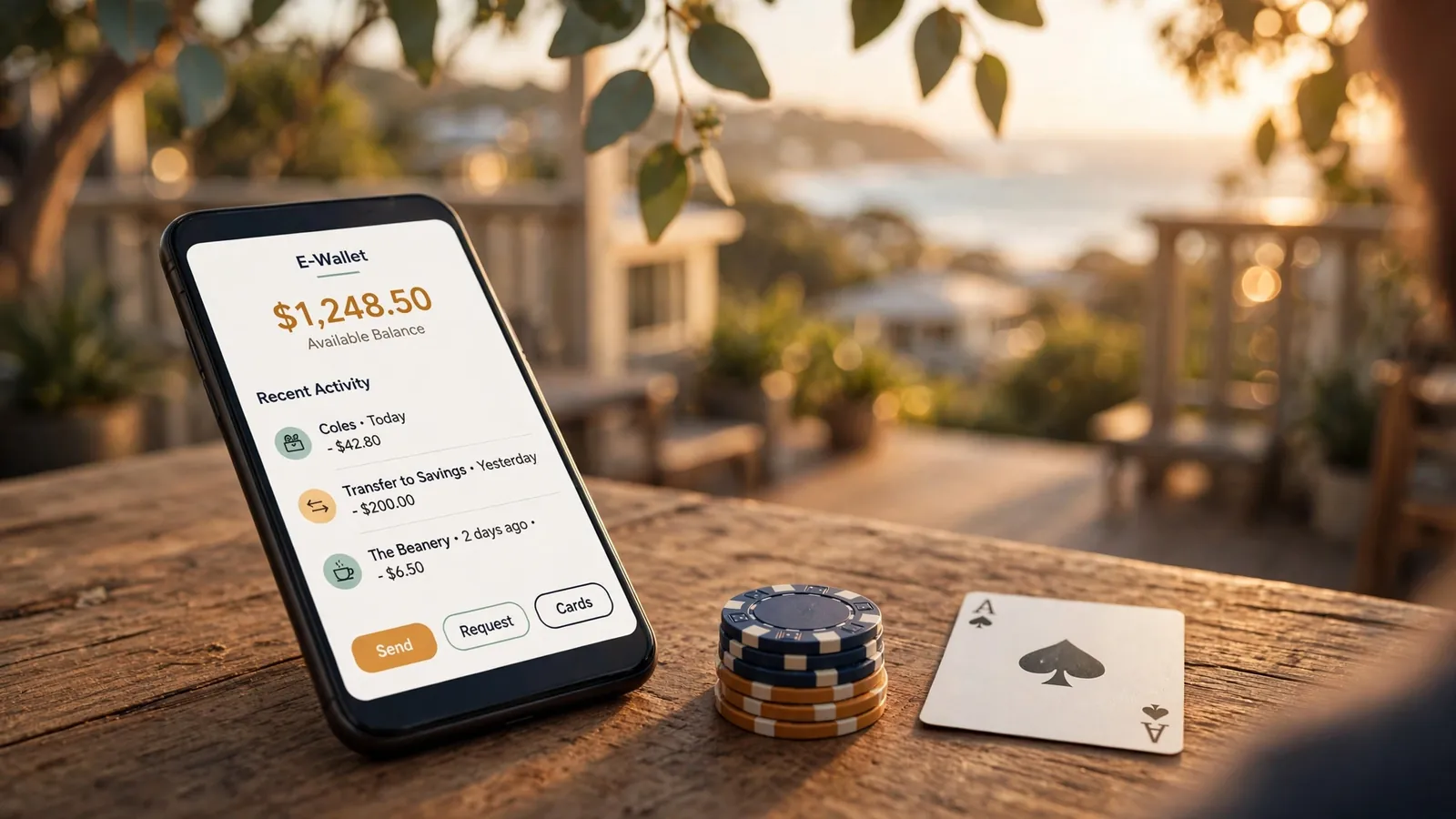
E-wallets can support deposits and withdrawals, but availability and account details depend on both the casino and provider.
How E-Wallets Fit Into the Pokies Payment Journey
An e-wallet sits between your usual source of funds and a casino’s cashier. Instead of entering bank or card details directly on the casino site for each transaction, you use an account with an e-wallet provider to make a payment. MiFinity, Skrill and Neteller are examples used for both deposits and withdrawals at some offshore crypto-friendly casinos.
That two-way use is the main reason an e-wallet can matter across the payment journey. A deposit moves funds from your e-wallet account to the casino balance; a withdrawal sends funds in the opposite direction. When the same wallet can handle both, it gives you one payment route to understand rather than separate arrangements for putting money in and taking it out. The details still depend on the casino and the wallet provider, so the payment logo alone does not tell you how an account will work.
The deposit side
At the deposit stage, the casino cashier is where you select a payment method and enter the information it requests. If an e-wallet is available there, you may be sent to the wallet provider to approve the payment before returning to the casino. Think of it as a hand-off between two services, not as one shared account.
When choosing an e-wallet option in Australia, check which payment methods are actually available to you and review the operator details before depositing. This list highlights the limited licensing, deposit and payout information provided for each operator.
1. Golden Pokies
License: Curacao
Golden Pokies is listed with a Curacao licence. No deposit or payout details are provided here, so check the available e-wallet options directly before you deposit.
2. Bizzo Casino
License: Curacao Gaming Control Board (TechSolutions Group N.V.)
Bizzo Casino is listed with a Curacao Gaming Control Board licence held by TechSolutions Group N.V. The available information does not specify its deposit or payout options.
3. JeetCity Casino
License: Curacao eGaming (Dama N.V.)
JeetCity Casino is listed with a Curacao eGaming licence held by Dama N.V. No e-wallet, deposit or payout details are provided here.
4. Thor Casino
License: Curacao – Antillephone N.V. (Versus Odds B.V.) · Min. deposit: EUR 20
Thor Casino is listed with a Curacao licence through Antillephone N.V. (Versus Odds B.V.) and a minimum deposit of EUR 20. The available details do not specify e-wallet or payout options.
5. Playfina Casino
License: Curacao eGaming (Hollycorn N.V., since 2017) · Min. deposit: A$20-30 (depends on the offer)
Playfina Casino is listed with a Curacao eGaming licence held by Hollycorn N.V., which is noted as operating since 2017. Its minimum deposit is A$20–30, depending on the offer; e-wallet and payout details are not provided.
6. Roby Casino
License: Curacao eGaming (Roby Games Ltd)
Roby Casino is listed with a Curacao eGaming licence held by Roby Games Ltd. No deposit or payout details are provided here.
7. SpinsUp
License: Curacao Gaming Control Board OGL/2023/174/0082 (Dama N.V.)
SpinsUp is listed with a Curacao Gaming Control Board licence, OGL/2023/174/0082, held by Dama N.V. The available information does not specify e-wallet, deposit or payout options.
8. JustCasino
License: Curacao Gaming Control Board
JustCasino is listed with a Curacao Gaming Control Board licence. No deposit or payout details are provided here, so confirm payment options directly.
9. House of Pokies
License: international iGaming licence – jurisdiction not named in the source · Payout speed: PayID 1-24 hours · Min. deposit: A$30 (PayID from A$10)
House of Pokies is listed with an international iGaming licence, but the jurisdiction is not named. Its stated PayID payout speed is 1–24 hours; the minimum deposit is A$30, or A$10 when using PayID.
10. WinSpirit Casino
License: Curacao eGaming OGL/2024/923/0383 (Antillephone N.V.) · Min. deposit: A$30
WinSpirit Casino is listed with a Curacao eGaming licence, OGL/2024/923/0383, through Antillephone N.V., and a minimum deposit of A$30. The available details do not specify e-wallet or payout options.
That separation can make it easier to keep track of which funds are in your wallet and which are sitting in the casino balance. It also means there are two sets of account details and rules to keep straight. A payment that appears in one account does not automatically explain what the other service will show, so check the status in the relevant account if something seems unclear.
An e-wallet is not a guarantee that a deposit will go through. The casino has to offer that method, and the provider must be available for your account and location. Before sending funds, check what the cashier says about the method and whether the wallet provider’s own requirements apply. I would not treat a familiar payment name as proof that every casino supports it in the same way.
The withdrawal side
For a withdrawal, the casino sends funds to the payment destination it allows for your account. If it supports your e-wallet for withdrawals, the wallet can be the receiving end of the same route used to deposit. That is why people look for e-wallets that work both ways, rather than choosing solely on the basis of a deposit button.
Keep the distinction clear: the casino balance and the e-wallet balance are separate. A withdrawal request begins with the casino, while the receiving wallet is where the funds are meant to arrive. Each service can have its own account checks and transaction status. If a payment appears to be waiting, first establish which service currently has the transaction to process; otherwise, it is easy to ask the wrong support team for an answer.
$2 Minimum Deposit Casinos in Australia
Also check the casino’s payment terms before relying on a particular route. Some casinos require withdrawals to return through a method used for deposits, while other methods may be available only for deposits. That can affect whether your chosen wallet is useful for the whole journey. The cashier and payment rules—not the name of the wallet—are what tell you.
A separate account means a separate check
Using a wallet does not remove the need to understand who is handling each part of a payment. You are dealing with the casino for the casino balance and transaction request, and with the e-wallet provider for the wallet account. Read the instructions on both sides, and do not assume that support at one service can resolve an issue controlled by the other.
The casinos discussed in this context are offshore and crypto-friendly, not Australian-licensed casino services. Confirm that a site accepts your location before depositing. The Interactive Gambling Act 2001 prohibits operators from providing online casino-style games to people in Australia. ACMA actively blocks access to illegal gambling sites, and using a VPN to reach a blocked casino may lead to winnings being voided or an account being closed. If an offshore casino refuses to pay, there is no Australian government body you can complain to for help recovering the winnings.
That is a serious downside, not a payment technicality. A wallet can organise how funds move; it cannot give you local protection or make a casino’s rules dependable. Keep that distinction in mind before treating a smooth-looking cashier as reassurance.
A specialist review describes responsible-gambling tools such as deposit and loss limits, controls on wagering, session-time settings and self-exclusion. Where a casino offers these, check how they work and consider setting controls before you begin. They are account safeguards, not payment features, and an e-wallet does not replace them.
The practical takeaway is simple: identify the wallet as a payment route, verify that it supports both the deposit and withdrawal you intend to make, and read the casino’s terms before using it. Familiar names can make the cashier easier to read. They do not settle the important questions for you.
Real-Money Play, Login Checks and the Offshore Catch
The legal line in Australia falls on the operator, not the individual punter. Under the Interactive Gambling Act 2001, an operator must not provide real-money online casino-style games to people located in Australia. That includes pokies and other casino games. The Act does not make it an offence for an individual Australian to play at an offshore casino, but that distinction should not be mistaken for local approval or protection.
Any casinos discussed in this context are offshore crypto-friendly casinos, not Australian-licensed services. They operate beyond Australia’s domestic framework, and the fact that an account can be opened or a login page loads does not mean the service is authorised to offer casino games here. I would keep those points separate: the law does not impose player liability for using an offshore casino, but the operator is not thereby entitled to serve Australian customers.
No Minimum Deposit Casinos in Australia: Payment Limits
The Australian Communications and Media Authority (ACMA) works to restrict access to illegal gambling services, including by blocking sites. A blocked page is a practical warning, not a technical puzzle to solve. If you are considering an offshore account, first confirm directly with the operator that it accepts customers at your location, before registering or depositing. A site’s general availability, an account form, or a payment option does not establish that your state or territory is accepted.
Do not use a VPN to get around a block or disguise where you are connecting from. If an operator treats that as a breach of its rules, it may close the account or refuse winnings. That risk can leave you arguing over an account with a business outside Australia, rather than resolving the issue through a local casino regulator. A workaround is not a safety net.
Age is another firm boundary: you must be at least 18 to register and gamble. That applies even if an offshore site lets you reach a registration screen. Treat the age requirement as a condition for participation, not as a box to click past. A login is only access to an account; it does not change the law applying to the service or remove the need to meet the operator’s conditions.
What a login does—and does not—settle
People often focus on whether they can sign in with an e-wallet-linked account or get back into a session. Those are access questions, not proof that the casino is suitable for someone in Australia. Before putting money into any account, read the operator’s location rules and its terms for account access. If the site does not clearly confirm that it accepts your location, do not assume that a successful registration settles the matter.
Do
- Confirm the operator explicitly accepts your location
- Read the location rules and account access terms
- Use a genuine website address
Don't
- Use a VPN to bypass blocks or disguise your location
- Assume a successful registration proves the site is authorised
- Trust a saved password as a substitute for site checks
The same caution applies if a page is reachable one day and blocked later. Access can change, and a working login is not a guarantee that the service will remain available or that a dispute will be handled locally. Keep your account details secure, but do not let the convenience of a saved password or familiar sign-in screen stand in for checking who is operating the site and where it accepts customers.
The limit of local recourse
If an offshore casino refuses to pay winnings or closes an account, there is no Australian government body for you to complain to about that refusal. That is the practical cost of dealing with an operator outside the domestic system. You may be able to contact the casino itself, but that is not the same as having an Australian authority able to resolve the dispute on your behalf.
I would not treat a foreign licence, polished website or easy sign-in as a substitute for local recourse. Those details do not turn an offshore service into an Australian one. The key checks are plain: you are at least 18, the operator explicitly accepts your location, and you understand that access may be blocked and that disputes over payment may have no Australian government complaint route. None of that makes the arrangement risk-free. Be clear-eyed.
What an Australian E-Wallet Casino Comparison Can—and Can’t—Tell You
A comparison of e-wallet options can help you identify what a particular offshore casino says it accepts. It cannot establish that the casino accepts people in Australia, that your e-wallet account will work there, or that a deposit method will also be available for withdrawals. Those details need checking on the operator’s own payment and account pages before you deposit.
$20 Minimum Deposit Pokies in Australia: What to Know
That distinction matters here. Under the Interactive Gambling Act 2001, operators cannot provide real-money online casino games to people in Australia. Any casinos discussed in this context are offshore and crypto-friendly, not Australian-licensed venues. You must confirm that a site accepts your location before depositing. A payment logo or an Australian-dollar option is not proof of location acceptance.
An e-wallet pokies list can therefore be a starting point for checking payment compatibility, not a dependable directory of local casinos. A list may name digital wallets, but it can go stale as operators change their payment options. Even when a wallet appears on a casino’s page, check whether it is available to Australian account holders and whether the rules differ for your chosen currency or account. Don’t assume that a method shown in a general payment menu is offered to every customer.
What the comparison should help you check
Look for the exact wallet name in the casino’s cashier, then confirm the details with the operator if anything is unclear. MiFinity, Skrill and Neteller are examples of e-wallets used for both deposits and withdrawals, but a casino’s acceptance of one does not imply acceptance of the others. You may also need an account with the wallet provider itself. The names on a comparison page are not a substitute for checking the live options available to you.
A useful comparison separates payment types rather than bundling them together. Mobile casino payment menus may include PayID, POLi, BPAY, cards and cryptocurrency, alongside e-wallets. A specialist review has reported these as deposit options, but availability can change and depends on the individual operator. Treat the menu as something to verify, not a promise that every method is currently available to every Australian user.
POLi needs particular care in any older comparison. It stopped operating in Australia in September 2023 and no longer processes local transactions. If a page still presents POLi as a working local option, that is a sign to check the rest of its payment information closely. An old label can hang around long after the service has gone.
Card payments deserve a separate check, too. A specialist review has noted that some Australian banks block or flag gambling-related card charges, which can lead to a deposit failing. A decline does not necessarily mean the casino’s cashier is broken; it may reflect a bank restriction. Don’t keep retrying a payment without understanding the reason or checking with your bank.
For any method, read the operator’s own terms before you use it. Check whether the payment service is available in your location, what the casino requires to connect it to your account, and whether the method is permitted for the transaction you intend to make. Deposit and withdrawal rules can differ; the comparison alone may not show the full account-specific conditions.
The limits of a list
A list cannot settle the bigger question of whether using a particular offshore site is right for you. The Australian Communications and Media Authority blocks access to illegal gambling sites, and using a VPN to reach a blocked casino may breach its terms, void winnings or lead to account closure. There is also no Australian government body to complain to if an offshore casino refuses to pay winnings. Keep those practical limits in view rather than treating a payment comparison as an endorsement.
$1 Minimum Deposit Casinos in Australia: What to Know
I’d be wary of any page that presents a broad list as if every entry were available to Australian punters. First confirm the site accepts your location, then check its current cashier and the wallet provider’s own requirements. If those answers are hard to find, that is useful information in itself. A tidy logo row is not a guarantee.
The sensible role of an e-wallet comparison is narrow: it can help you know which payment names to look for and which claims to verify. It should not be read as proof of local approval, reliable access, or a route around Australian restrictions. Verify the details directly, and don’t deposit until the location and payment rules are clear.
AUD Deposits, Withdrawal Rules and Limits
When you look at an e-wallet for pokies, separate three questions: whether the casino accepts the wallet, whether the account can withdraw to it, and how the casino handles Australian dollars. A payment option shown on a cashier page does not answer all three. Check the terms that apply to your account before you deposit, rather than relying on a general payment-method page.
The important detail is the casino’s withdrawal rule. Some casinos require you to withdraw through the same method you used to deposit; others treat certain options as deposit-only. A specialist review describes both types of rule, but the policy can differ between casinos and may change. Read the cashier instructions and withdrawal terms together. If they are unclear, ask the operator to confirm in writing whether your chosen e-wallet can receive withdrawals before you put money in.
- Check if the casino requires withdrawals via the same method used for deposit
- Confirm in writing if your chosen e-wallet can receive withdrawals
- Identify if any alternative payout methods are permitted
That small check can prevent a frustrating surprise later. A wallet appearing beside the deposit field does not, by itself, mean it is available for cashing out. Nor should you assume that using one wallet for a deposit means you can switch to another for a withdrawal. Find out whether the operator applies a same-method rule, whether it allows an alternative, and what you would need to do if the original wallet cannot be used.
Check the AUD handling
An Australian punter should also confirm what happens to the currency between the bank, the e-wallet and the casino balance. Look for an explicit AUD option in the cashier, and check whether the amount you enter is charged in AUD or converted to another currency. If conversion is involved, find out which party performs it and whether a fee or exchange-rate difference applies. Do not infer the answer from the currency symbol alone: check the payment screen and the wallet’s own terms.
Keep the transaction records. Your e-wallet statement and the casino account history can help you compare what left the wallet with what the casino credited. If the figures do not match, check the currency and any conversion details before making another payment. That is a practical record-keeping step, not a guarantee that a dispute will be resolved in your favour.
Some Australian banks may flag or block gambling-related card payments, so a card funding a wallet can behave differently from a transfer into it. A specialist review reports this as a possible reason for a card deposit to fail. If that happens, check with your bank and wallet provider rather than repeatedly retrying the same transaction. Do not assume that a different route is permitted: the casino’s own payment rules still apply.
$10 Minimum Deposit Pokies in Australia: What to Check
Withdrawal caps are a separate rule
A payment method and a withdrawal limit are different parts of the account terms. A specialist review reports that some casinos set weekly or monthly withdrawal caps, with reported weekly figures in the $4,000–$10,000 range. Treat that range as a prompt to inspect the specific operator’s terms, not as a standard limit or a promise that it applies to your account. Check whether a cap is stated per account, per method or over a set period, and whether the rules distinguish between ordinary funds and winnings.
A cap can affect how much you can request at once, even if the e-wallet is available for withdrawals. Read the limit alongside any minimum or maximum transaction rules shown for that method. If the terms are vague, get the operator’s answer before depositing; sorting out the meaning after a balance has built up is the harder order.
These are account and currency checks, not processing-time estimates. A casino may approve a withdrawal under its rules and still have a separate pending stage before the e-wallet provider handles it. Keep those questions apart: first establish whether a withdrawal is allowed, through which method, and under what limit; then check how long each stage may take.
One broader caution matters here. Real-money online casino-style games are prohibited for operators providing them to people in Australia, and the Australian Communications and Media Authority blocks access to illegal gambling sites. Any casino being considered in this context is offshore and crypto-friendly, not an Australian-licensed venue. Confirm that it accepts your location before depositing. Using a VPN to reach a blocked site may lead to winnings being voided or the account being closed. If an offshore operator refuses to pay, there is no Australian government body for you to complain to about that casino.
So before using an e-wallet, confirm the currency treatment, the deposit-to-withdrawal rule and any withdrawal cap in the actual account terms. Keep a copy of what you checked. A familiar wallet name is not enough; the rule attached to it is what counts.
New to Mobile Pokies? Browser Play Is the Usual Route
If you are new to playing on a phone, start with the casino’s website in your mobile browser. For Australian users, that is generally the normal route: many offshore operators that accept Australian players provide browser access or a Progressive Web App (PWA), rather than a native app. You can often sign in with the same account you use on a desktop.
That matters because a casino app is not necessarily waiting for you in the app store. Casino apps are rarely listed on Google Play or Apple’s App Store in Australia, so a missing listing is not a reason to hunt through random download pages. Browser play avoids installing extra software: open the website, sign in, and use its mobile layout. If a page behaves badly, try refreshing it or closing other open tabs before assuming your phone needs a new app.
Real Money Pokies on Android in Australia
Browser access and PWAs
A PWA is essentially a shortcut to a casino website, designed to behave more like an app on your device. If the site offers one, it may show an install or add-to-home-screen prompt while you are browsing. Tap that prompt and confirm the installation; the shortcut should then appear on your home screen.
The important distinction is that a PWA is still tied to the website. It is not proof that an operator has a locally approved app, and adding a shortcut does not change the account or the terms attached to it. I would first open the site directly in the browser and check that the address is the operator’s genuine website. Only then consider adding its shortcut. A familiar-looking icon is no substitute for checking where it leads.
If no install prompt appears, you have not necessarily done anything wrong. The operator may not offer a PWA, or your browser may handle the prompt differently. You can keep using the site in the browser instead. There is no need to search for a separate file just to make the home screen look tidier.
Be careful with app downloads
Some operators may direct users to download an app outside the official app stores. That is sideloading, and it carries security risks. How safe a file is depends on the operator and how it distributes and maintains the app; a download link alone cannot establish that it is trustworthy. Avoid treating a polished page or a familiar brand style as a security check.
An app may request access to information or device functions that are not needed for ordinary browser access. Before installing anything, read the permissions and consider whether you are comfortable with them. If you cannot tell who provides the file or why it needs the access it requests, do not install it. Browser play is the simpler default, not a lesser version of the experience.
Social and free-play casino apps are a different category: they use virtual credits and are available through the official app stores in Australia. Their presence there does not mean a real-money casino app is also approved or available through those stores. Keep that distinction clear when you are browsing.
Location, blocked access and account checks
Any casinos discussed in this context are offshore and crypto-friendly, not Australian-licensed real-money casinos. Before depositing, you must confirm that the site accepts your location. Do not use a VPN to get around a block or location restriction: using one to access a blocked casino may lead to winnings being voided or the account being closed. ACMA actively blocks illegal gambling sites, so a page failing to load is not an invitation to find a workaround.
There is also a practical limit to recourse. If an offshore casino refuses to pay winnings, there is no Australian government body for you to complain to about that dispute. That is worth understanding before creating an account, not after a withdrawal becomes difficult.
Mobile access does not remove identity checks. A first withdrawal commonly triggers KYC verification, which can involve providing a selfie or identity document and proof of address. Make sure the account details you entered are accurate and that you can access the documents requested. A request for verification at that point is not the same thing as a browser fault, and repeatedly reinstalling an app will not resolve it.
One sensible setup: use the browser, check the site address, and keep control of your documents and account details. If you choose a PWA, install it only through the website itself. And if an operator pushes you towards an unclear download or asks you to bypass a block, stop there. No shortcut is worth that risk.
Safe Online Casinos in Australia: What to Check
E-Wallet Casino Payments: What to Expect From Processing Times
An e-wallet payment has two separate stages when you withdraw: the casino first reviews and releases the request, then the payment provider processes it. Those stages are easy to blur together when a balance has not appeared yet, but they are not the same wait.
A specialist payment review describes e-wallet withdrawals as arriving within 24 hours after the casino’s pending period. That timing does not include the time the casino takes before releasing the payment. If a request is still marked pending, the e-wallet may not have received it yet.
The same kind of review puts e-wallet and crypto withdrawals at under 24 hours for processing. Read that as a reported processing estimate, not a promise that the full journey from clicking “withdraw” to seeing funds is under 24 hours. The casino’s review stage comes first, and the actual sequence can depend on the operator and payment provider. Check the cashier’s stated stages rather than treating one headline figure as the whole timeline.
Deposits and withdrawals are different clocks
For deposits, a specialist payment review describes PayID as near-instant and typically free. That is a report about PayID, not a blanket timing rule for e-wallet deposits. E-wallet deposit processing can vary, so check the payment screen and the operator’s terms before relying on an immediate credit. A payment confirmation from your wallet also does not necessarily mean the casino has already updated your balance.
Processing Time Comparison
A specialist payment review notes that PayID is typically near-instant and free, while bank transfers can take up to five business days. However, e-wallet speed refers to the processing stage and does not include the casino's own pending review period.
For withdrawals, the clearest comparison in a specialist review is with bank transfer: that route can take up to five business days. An e-wallet may therefore be described as faster at the payment-processing stage, but the comparison still does not erase the casino’s own pending period. Business-day wording matters too: it is not the same as a count of ordinary hours.
If a withdrawal seems stuck, first check whether the casino has released it or whether it remains pending. Then check the wallet’s transaction history and any status message in the casino account. That helps you distinguish a casino-side wait from a provider-side delay before contacting support. Keep the transaction reference and any confirmation messages; they make it easier to explain which stage you are asking about.
Do not assume that the deposit speed predicts the withdrawal speed. They are separate transactions, and the withdrawal includes the casino’s review step. A quick deposit is not evidence that a later payout will follow the same path.
These time descriptions come from specialist payment reviews, so treat them as reported guidance rather than guarantees for every offshore crypto-friendly casino. If you are considering one, confirm that it accepts your location before depositing. Australian authorities block access to illegal gambling sites; using a VPN to reach a blocked site may breach its terms, void winnings or lead to account closure. There is no Australian government body to complain to if an offshore casino refuses to pay winnings.
Keep the timing question narrow: when does the casino release the withdrawal, and how long does the e-wallet take after that? A single “fast payout” label rarely answers both.
No-Deposit Bonuses: Read the Conditions Before You Claim
A no-deposit offer can sound straightforward: you do not pay in to receive it. That does not tell you whether you can use it on the games you want, how much wagering is required, or whether any winnings can be withdrawn. The terms decide that. Read them before you opt in, not after you have started playing.
Casino Features for Australian Players
Pay particular attention to the wagering requirement. It sets how much qualifying play must be completed before a bonus or related winnings become eligible for withdrawal. A specialist review gives welcome-bonus requirements in the 30x–50x range and describes anything above 40x as steep. Treat those as that review’s benchmarks, not a promise about what an offer will require. Check the actual calculation: the terms should make clear what amount the multiplier applies to and which activity counts.
Game restrictions matter just as much. An offer may exclude some games or count different games differently towards wagering. If the eligible games are not spelled out clearly, you cannot sensibly judge how demanding the requirement will be. Check the expiry date too. A short window can make an otherwise understandable requirement difficult to complete, and missing the stated deadline may mean losing the offer.
Then look for a cashout cap: the maximum amount that can be withdrawn from bonus play. A cap can limit the value of winnings even after you meet the wagering requirement. Also check whether a minimum deposit is required, whether the offer is genuinely available without one, and what happens if you decline or opt out. Minimum deposits, wagering rules and time limits all affect whether an offer is usable; the headline alone does not.
$5 Minimum Deposit Pokies in Australia: What to Know
For an e-wallet offer, read any payment-related conditions as well. Do not assume that the method you use to claim an offer will be available for withdrawing funds. The casino’s terms should explain the relevant restrictions.
Any such offer discussed here would be from an offshore, crypto-friendly casino, not a locally licensed Australian casino. Before depositing, confirm that the site accepts your location. Do not use a VPN to get around a block: access may be blocked, and using one may lead to winnings being voided or an account being closed. There is no Australian government body to complain to if an offshore casino refuses to pay winnings.
My rule is simple: check wagering requirements, eligible games, expiry dates and cashout caps before claiming. If the terms are unclear, leave the offer alone. A bonus is not free money.
Can I play mobile casinos for real money without an app?
Yes. Most casinos that accept Australian players can be accessed through a mobile browser, so you can play without downloading a dedicated app.
Do players usually need to download a dedicated casino app?
No. Browser play is the default, and some casinos offer a Progressive Web App you can add to your home screen instead of installing a native app.
How do wagering requirements actually work in practice?
A wagering requirement sets how many times the bonus amount must be wagered before the bonus is cleared. Welcome bonus requirements commonly range from 30x to 50x, and many must be cleared within 7–10 days.
Should I accept a welcome bonus?
Check the wagering requirement, minimum deposit and time limit before accepting. Requirements above 40x are considered steep, and missing the deadline can mean losing the bonus.
Can I use the same account on my phone and computer?
Yes. Mobile casinos are generally accessed through a browser using the same account as on desktop.
Can players use real-money mobile casinos in Australia?
Australian players are not personally committing an offence under the Interactive Gambling Act 2001 by playing at an offshore casino, but operators are prohibited from offering online casino-style games to people in Australia. Offshore casinos are not Australian-licensed, and ACMA blocks access to illegal gambling sites.
Casino Features for Australian Players
Content created by the «fastpaycasinohubau.com» team